Efficiency Maine Insulation Rebates: Save Up to $8,600 on Your Home

Maine homeowners earn a set rebate for each area of the home they insulate through the Efficiency Maine Home Rebate Program. As a Registered Vendor, Mattra handles the diagnosis, installation, and all rebate paperwork. You get a warmer home and the maximum rebate you qualify for.

Efficiency Maine Registered Vendor BPI Certified IICRC Certified Over 30 Years in Maine

Efficiency Maine Insulation Rebate Program

The Efficiency Maine Home Rebate Program helps Maine homeowners offset the cost of home insulation improvements. Through the Home Energy Savings Program (HESP), homeowners at any income level can receive rebates that cover a significant percentage of their insulation project.

The program works through a network of Registered Vendors like Mattra. We perform an energy assessment, identify where your home is losing heat, and recommend the scope of work that qualifies for the highest rebate. After the installation, we submit the documentation and you receive the rebate.

For most Maine homes, insulation and air sealing are the two upgrades with the fastest return on investment. The rebate reduces the upfront cost. The energy savings reduce your heating bills every year after that.

Any-Income Rebates Available

Every Maine homeowner qualifies at the Any Income tier with no income verification. Income-eligible households earn more per area at the Moderate and Low Income tiers.

Insulation Rebate Tiers by Income Level

All Maine homeowners qualify for a rebate. Each area you insulate earns its own set amount, and the amount per area increases for moderate- and low-income households.

Every AREA of your home earns its own rebate. Attic, wall, and basement are counted separately, so the amounts add together. The most any home can receive in total is $8,600 ($5,600 for a mobile home).

Any Income
$8,600
Maximum rebate

Per AREA insulated (500+ sq ft)

 Attic$2,000
+Wall$2,000
+Basement$2,000
+Air sealing$300
=Total$6,300

Those three areas come to $6,300. Reaching the full $8,600 depends on your home, so let’s walk through it together.

All Maine homeowners qualify. No income verification required.

Moderate Income
$8,600
Maximum rebate

Per AREA insulated (500+ sq ft)

 Attic$3,000
+Wall$3,000
+Basement$3,000
+Air sealing$450
=Total$9,450

Adds up to $9,450, but the program caps a home at $8,600.

Verification required through Efficiency Maine. Adjusted Gross Income up to $70,000 for individual filers, or $100,000 for joint filers.

Low Income
$8,600
Maximum rebate

Per AREA insulated (500+ sq ft)

 Attic$4,000
+Wall$4,000
+Basement$4,000
+Air sealing$600
=Total$12,600

Adds up to $12,600, but the program caps a home at $8,600.

Qualifies through participation in HEAP, MaineCare, TANF, or SNAP. Verification required. Mobile homes earn their own underbelly rebate of up to $5,000.

Automatic Qualification for the Low Income Tier

If your household currently participates in any of the following programs, you qualify for the Low Income tier, the highest amount per area:

  • HEAP (Home Energy Assistance Program)
  • SNAP (Food Stamps)
  • TANF (Temporary Assistance)
  • MaineCare

Air sealing now earns its own rebate on top of insulation: up to $300 for the attic, $200 for a basement or mobile home underbelly, and $100 for the living space, depending on income tier.

Check My Rebate Eligibility

Who Qualifies for Efficiency Maine Insulation Rebates?

The rebate program is available to most Maine homeowners. Below are the requirements and exclusions.

You Qualify If:

  • Your building is in Maine
  • It is a single-family home, two-unit duplex, condominium, mobile home, or mixed-use building with one or two housing units and no commercial electric meter
  • The space being insulated is heated for the entire heating season
  • The work is done by an Efficiency Maine Residential Registered Vendor
  • You file the claim within six months of finishing the work
  • You have not already reached the lifetime limit for the building

Does Not Qualify:

  • New construction or additions
  • Buildings with three or more housing units
  • Buildings with a commercial electric meter
  • Mobile home walls and skirting (the underbelly does qualify)
  • Space that already has more insulation than the program limit

Rentals and Seasonal Homes

Rental properties and seasonal homes qualify at the any-income tier, as long as the space being insulated is heated for the entire heating season. The low- and moderate-income tiers also require the home to be the owner's principal residence, and the household must be verified by Efficiency Maine before the work starts.

Existing Insulation Limits

The rebate only covers space whose existing insulation is at or below a limit: attics R-21 or less, walls R-5 or less, basements R-5 or less, and mobile home underbellies R-11 or less. Any portion above the limit is excluded. Efficiency Maine also requires blower door tests before and after the work (with a few exceptions), and the finished job must meet its Weatherization Requirements Checklist, including R-49 for a blown-in attic. Mattra measures what you have at the free assessment, so you know before any work starts whether an area qualifies.

Maine Insulation Rebates at Every Income Level

You do not need to be low-income to benefit from the Efficiency Maine rebate program. The any-income tier is available to every qualifying building in Maine, including rentals and seasonal homes, with no income verification required.

What the Any-Income Tier Covers

  • Air Sealing — its own rebate of up to $300 (attic), $200 (basement or mobile home underbelly), or $100 (living space). Sealing air leaks around framing, plumbing, and electrical penetrations is the foundation of any insulation project.
  • Insulation — up to $2,000 per area at any income ($1,000 for a smaller area). Covers attic, wall, and basement insulation upgrades including blown-in insulation, spray foam, and dense-pack cellulose.

Maine homeowner reviewing Efficiency Maine rebate savings with Mattra contractor

Lifetime Limits

The program pays one insulation rebate and one air sealing rebate per area, up to a lifetime total of $8,600 per building ($5,600 for a mobile home). Rebates you already received count toward that total, including any paid under the earlier percentage program, so a $4,000 rebate in the past leaves $4,600. A mobile home qualifies for a basement or an underbelly rebate, but not both, and mobile home walls and skirting are not covered. To finance what is left after the rebate, see Efficiency Maine Home Energy Loans.
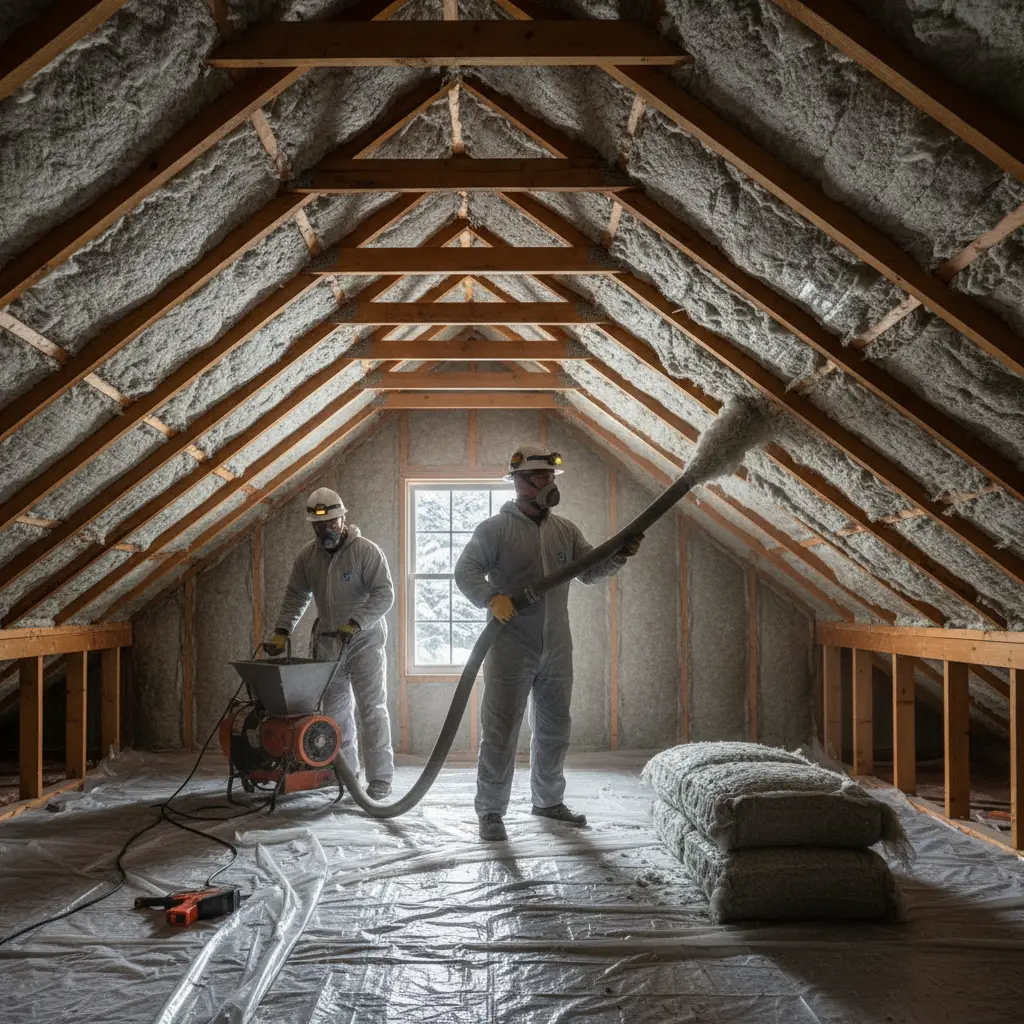
Insulation Upgrades That Qualify for Maine Rebates

The Efficiency Maine program covers multiple types of insulation work. Each addresses a different part of your home's thermal envelope.

Air Sealing

Sealing air leaks around plumbing, wiring, ductwork, and framing penetrations stops the heat loss that insulation alone cannot address. Air sealing now earns its own rebate, so it does not have to be paired with insulation.

Learn About Air Sealing

Attic Insulation

The largest single source of heat loss in most Maine homes. Blown-in cellulose or fiberglass brings attic R-values up to current standards, reducing heating costs and preventing ice dams.

Learn About Attic Insulation

Wall Insulation

Older Maine homes often have minimal or compressed wall insulation. Dense-pack cellulose and blown-in insulation methods upgrade thermal performance for residential insulation contractors projects without major renovation.

Learn About Wall Insulation

Basement Insulation

Cold basement walls and rim joists let heat escape from the entire house above. Spray foam and rigid board insulation seal the basement envelope and improve comfort on every floor.

Learn About Basement Insulation

Looking for more detail on insulation types? See our full insulation services page or explore blown-in insulation and spray foam insulation options.

Maine Insulation Contractors You Can Trust

Choosing the right contractor matters as much as choosing the right insulation. As an Efficiency Maine Registered Vendor with BPI certification and over 30 years of building science experience, Mattra brings diagnostic expertise that most insulation companies do not offer.

We serve homeowners across Maine from our base in Lewiston-Auburn, including Auburn, Bethel, Lisbon, Topsham, Brunswick, Monmouth, and surrounding communities. Whether you need attic insulation in Monmouth or basement spray foam in Brunswick, we diagnose the problem before prescribing the solution.

Mattra insulation crew completing a residential insulation project in Maine
✔

Efficiency Maine Registered Vendor

We are authorized to perform rebate-qualifying work and submit all required documentation directly to Efficiency Maine on your behalf.

🏠

BPI Certified Building Analysts

Our team holds Building Performance Institute certifications in building science, ensuring every diagnosis is based on how your home actually performs.

📋

Full Rebate Paperwork Handled

From the HESP Energy Assessment Checklist to the final rebate submission, we complete and file every document. You receive the rebate without the hassle.

🔧

30+ Years in Maine

We understand Maine's climate, building stock, and the specific insulation challenges that come with older New England homes.

Efficiency Maine Insulation Rebate FAQ

The rebate is a set amount for each area of the home you insulate. Per area, any-income households receive $1,000 to $2,000, moderate-income $1,500 to $3,000, and low-income $2,000 to $4,000, depending on how much space is insulated. A mobile home underbelly earns up to $5,000. Air sealing earns its own rebate of $50 to $300 per area. Lifetime totals are capped at $8,600 per home, or $5,600 per mobile home.

To qualify, the building must be in Maine and be a single-family home, two-unit duplex, condominium, mobile home, or a mixed-use building with one or two housing units and no commercial electric meter. The work must be done by an Efficiency Maine Residential Registered Vendor, it cannot be part of a new home or addition, and the space being insulated must be heated for the entire heating season. Rental properties and seasonal homes qualify at the any-income tier. The low- and moderate-income tiers also require the home to be the owner's principal residence and the household to be verified by Efficiency Maine before the work. A claim must be filed within six months of completing the work.

The rebate covers air sealing, attic insulation, wall insulation, and basement insulation. This includes blown-in cellulose, fiberglass, and spray foam. Each area of the home has a separate rebate allowance, and air sealing is the required starting point before insulation rebates apply.

Yes. As a Registered Vendor, we complete and submit all required documentation including the HESP Energy Assessment Checklist that must accompany insulation rebate claims. You receive the rebate. We handle the paperwork.

You qualify for the Low Income tier — $2,000 to $4,000 per area insulated — if you participate in HEAP, SNAP, TANF, or MaineCare. If you're not enrolled in those programs, you may still qualify based on household income. We help determine your eligibility during the free inspection.

Your claim must be emailed or postmarked within six months of finishing the work, and Efficiency Maine asks you to allow about six weeks for processing. Mattra prepares and submits the paperwork. Low-income rebates are paid to the contractor, so they show up as a discount on your bill. Because the rebate is tied to the date the work is completed, there is no benefit to rushing a decision, but there is also no reason to let a finished job sit unclaimed.

Rebate Funds Are Limited. Start Your Project Now.

Efficiency Maine rebate budgets are allocated annually and run out. The sooner you schedule your free inspection, the sooner we can determine your eligibility, recommend the right scope of work, and lock in your rebate before funds are exhausted.

No diagnostic equipment fees. No pressure to commit. We handle all Efficiency Maine rebate paperwork.

Mattra Inc. · 68 Whipple St · Lewiston, ME 04240
info@mattrainc.com · Rebates & Financing Guide